Guided Reading Activity World War 1 and the Russian Revolution Answers
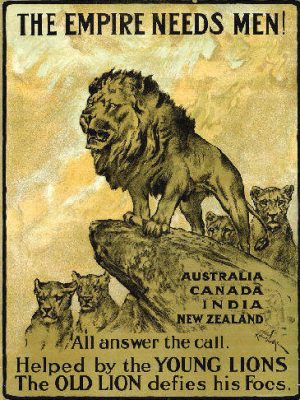
Nationalism was a prominent force in early on 20th century Europe and a significant cause of World War I. Nationalism is an intense grade of patriotism or loyalty to one's land. Nationalists exaggerate the importance or virtues of their home country, placing its interests above those of other nations.
Feelings of supremacy
In the 19th and early 20th centuries, many Europeans, specially citizens of the then-called Not bad Powers (Britain, France and Germany) had convinced themselves of the cultural, economic and military supremacy of their nation. According to historian Lawrence Rosenthal, this sentiment was:
"…a new and aggressive nationalism, different from its predecessors, [that] engaged the fierce us-them group emotions – loyalty in, assailment outwards – that characterise man relations at simpler sociological levels, like the family or the tribe."
The effects of this growing nationalism were an inflated confidence in one'south nation, its government, economy and war machine ability. Many nationalists as well became bullheaded to the faults of their own nation. In matters of strange affairs or global contest, they were convinced that their land was fair, righteous and beyond fault.
In dissimilarity, nationalists criticised rival nations to the point of demonisation, caricaturing them as aggressive, scheming, mendacious, astern or uncivilised. Nationalist printing reports convinced many readers the interests of their country were beingness threatened by the plotting, scheming and hungry imperialism of its rivals.
Sources of nationalism
The origins of this intense European nationalism are a matter of debate. Nationalism is probable a product of Europe'due south complex modern history. The rise of popular sovereignty (the involvement of people in government), the formation of empires and periods of economic growth and social transformation all contributed to nationalist sentiments.
Some historians suggest that nationalism was encouraged and harnessed by European elites to encourage loyalty and compliance. Others believe that nationalism was a past-product of economic and majestic expansion. Growth and prosperity were interpreted by some every bit a sign of destiny. Other nations and empires, in dissimilarity, were dismissed as inferiors or rivals.
Politicians, diplomats and royals contributed to this nationalism in their speeches and rhetoric. Nationalist sentiment was too prevalent in press reporting and popular culture. The pages of many newspapers were filled with nationalist rhetoric and provocative stories, such as rumours about rival nations and their evil intentions. Nationalist ideas could also be institute in literature, music, theatre and fine art.
In each country, nationalism was underpinned by different attitudes, themes and events. Nationalist sentiment was fuelled by a sense of historical destiny and, therefore, closely tied to the history and evolution of each nation.
Military over-confidence
Nationalism was closely linked to militarism. It fostered delusions about the relative war machine force of European nations. Many living in the Great Powers considered their nations to exist militarily superior and better equipped to win a future state of war in Europe.
The British, for case, believed their naval power, coupled with the size and resource of the British Empire, would give them the upper hand in any state of war. Beingness an island also isolated United kingdom from invasion or foreign threat.
German leaders, in contrast, placed bang-up faith in Prussian military efficiency, the nation'south powerful industrial base, her new armaments and her expanding armada of battleships and U-boats (submarines). If war erupted, the German high control had great confidence in the Schlieffen Plan, a preemptive military strategy for defeating France before Russian federation could mobilise to back up her.
In Russian federation, Tsar Nicholas Ii believed his empire was sustained by God and protected by a massive continuing army of 1.5 million men, the largest peacetime land strength in Europe. Russian commanders believed the country'due south enormous population gave it the whip hand over the smaller nations of western Europe.
The French placed their faith in the country'due south heavy industry, which had expanded rapidly in the late 1800s. Paris also played great stock in its defences, peculiarly a wall of concrete barriers and fortresses running the length of its eastern border.
Attitudes to war
Nationalist and militarist rhetoric assured Europeans that if state of war did erupt, their nation would sally as the victor. Forth with its dangerous brothers, imperialism and militarism, nationalism fuelled a continental delusion that contributed to the growing mood for war.
By 1914, Europeans had grown apathetic and dismissive well-nigh the dangers of war. This was understandable. Bated from the Crimean War (1853-56) and the Franco-Prussian War (1870-71), the 1800s was a century of comparative peace in Europe. With the exception of France, defeated by the Prussians in 1871, the Slap-up Powers had non experienced a significant military machine defeat for more than half a century.
For most Europeans, the experiences of war were distant and vague. The British and French had fought colonial wars in Africa and Asia only they were cursory conflicts against disorganised and underdeveloped opponents in faraway places. Militarism and nationalism revived the prospects of a European war, as well every bit naivety and overconfidence almost its likely outcomes.
'Invasion literature'
By the tardily 1800s, some Europeans were almost drunk with nationalist sentiment. In some respects, this was a production of overconfidence fuelled by decades of relative peace and prosperity.
Great britain, for example, had enjoyed two centuries of imperial, commercial and naval dominance. The British Empire spanned 1-quarter of the globe and the lyrics of a pop patriotic song, Rule, Britannia!, trumpeted that "Britons never, never will be slaves". London had spent the 19th century advancing her majestic and commercial interests and avoiding wars. The unification of Germany, the speed of German armament and the bellicosity of Kaiser Wilhelm II, nevertheless, caused business organization amidst British nationalists.
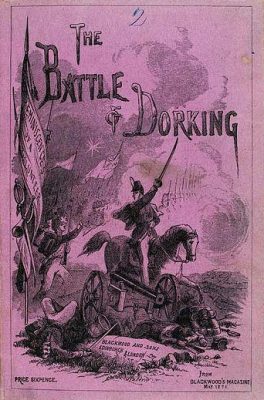
England's 'penny press' (a collective term for inexpensive, serialised novels) intensified nationalist rivalry by publishing incredible fictions nearly strange intrigues, espionage, future war and invasion. The Boxing of Dorking (1871), one of the best-known examples of 'invasion literature', was a wild tale about the occupation of England by German forces. By 1910, a Londoner could buy dozens of tawdry novellas warning of High german, Russian or French assailment.
Invasion literature often employed racial stereotypes or innuendo. The German was depicted as cold, emotionless and computing; the Russian was an uncultured barbaric, given to wanton violence; the Frenchman was a leisure-seeking layabout; the Chinese were a race of murderous, opium-smoking savages.
Penny novelists, cartoonists and satirists also mocked foreign rulers. The German Kaiser and the Russian Tsar, both frequent targets, were ridiculed for their airs, appetite or megalomania.
German nationalism
Attitudes and overconfidence in Germany was no less intense. German nationalism and xenophobia, however, had different origins to those in Uk.
Dissimilar U.k., Deutschland was a comparatively immature nation, formed in 1871 after the unification of 26 German language-speaking states and territories. The belief that all German language-speaking peoples should be united in a unmarried empire, or 'Pan-Germanism', was the political glue that jump these states together.
The leaders of postal service-1871 Germany employed nationalist sentiment to consolidate the new nation and gain public support. German culture – from the poetry of Goethe to the music of Richard Wagner – was promoted and celebrated.
German nationalism was likewise bolstered by German militarism. The strength of the nation, German language leaders believed, was reflected by the force of its armed services forces.
The nationalist Kaiser
The new Kaiser, Wilhelm 2, became the personification of this new, nationalistic Germany. Both the Kaiser and his nation were young and aggressive, obsessed with armed services power and purple expansion, proud of Germany'due south achievements but envious of other empires.
To Wilhelm and other German language nationalists, the main obstacle to German expansion was Britain. The Kaiser envied Britain's vast empire, commercial enterprise and naval power – but he thought the British avaricious and hypocritical. London oversaw the world's largest empire yet manoeuvred confronting German colonial expansion in Africa and Asia.
Equally a consequence, United kingdom of great britain and northern ireland became a popular target in the pre-war German press. Britain was painted every bit expansionist, selfish, greedy and obsessed with coin. Anti-British sentiment intensified during the Boer War of 1899-1902, Great britain'south war against farmer-settlers for control of South Africa. Ernst Lissauer's 1914 'Hassgesang gegan England' ('Song of Hate for England') is ane of the all-time-known examples of anti-English sentiment.
Independence movements

Equally the Not bad Powers of Europe beat their chests, another form of nationalism was on the rise in southern and eastern Europe. This nationalism was not about supremacy or empire only the right of ethnic groups to independence, autonomy and cocky-government.
With the earth divided into big empires and spheres of influence, many regions, races and religious groups sought freedom from their imperial masters. In Russia, more than lxxx ethnic groups in eastern Europe and Asia had been forced to speak the Russian language, worship the Russian tsar and practice the Russian Orthodox faith.
For much of the 19th century, China had been 'carved up' and economically exploited past European powers. The failed Boxer Rebellion of 1899-1900 was an endeavour to expel foreigners from parts of Cathay. Later, resentful Chinese nationalists formed cloak-and-dagger groups to wrest back control of their country.
Nationalist groups contributed to the weakening of the Ottoman Empire in eastern Europe past seeking to throw off Muslim rule.
Balkan nationalism
None of these nationalist movements contributed more directly to the outbreak of war than Slavic groups in the Balkans. Pan-Slavism, a belief that the Slavic peoples of eastern Europe should accept their own nation, was a powerful force in the region. Slavic nationalism was strongest in Serbia, where it had risen significantly in the tardily 19th and early 20th centuries.
Pan-Slavism was especially opposed to the Austria-hungary and its control and influence over the region. Aggravated by Vienna'south looting of Republic of bosnia and herzegovina, many young Serbs joined radical nationalist groups like the 'Blackness Manus' (Crna Ruka).
These groups hoped to drive Austro-hungarian empire from the Balkans and establish a 'Greater Serbia', a unified state for all Slavic people. It was this pan-Slavic nationalism that inspired the bump-off of Archduke Franz Ferdinand in Sarajevo in June 1914, an event that led directly to the outbreak of World State of war I.

1. Nationalism was an intense form of patriotism. Those with nationalist tendencies celebrated the civilization and achievements of their ain country and placed its interests above those of other nations.
2. Pre-war nationalism was fuelled by wars, imperial conquests and rivalry, political rhetoric, newspapers and popular culture, such as 'invasion literature' written by penny press novelists.
three. British nationalism was fuelled by a century of comparative peace and prosperity. The British Empire had flourished and expanded, its naval strength had grown and Britons had known only colonial wars.
iv. German nationalism was a new miracle, emerging from the unification of Germany in 1871. It became fascinated with German imperial expansion (securing Germany's 'place in the lord's day') and resentful of the British and their empire.
5. Ascent nationalism was also a factor in the Balkans, where Slavic Serbs and others sought independence and autonomy from the political domination of Austria-Republic of hungary.
Championship: "Nationalism as a cause of Globe State of war I"
Authors: Jennifer Llewellyn, Steve Thompson
Publisher: Blastoff History
URL: https://alphahistory.com/worldwar1/nationalism/
Date published: September 7, 2020
Appointment accessed: February 17, 2022
Copyright: The content on this folio may not be republished without our express permission. For more information on usage, please refer to our Terms of Use.
Guided Reading Activity World War 1 and the Russian Revolution Answers
Source: https://alphahistory.com/worldwar1/nationalism/
0 Response to "Guided Reading Activity World War 1 and the Russian Revolution Answers"
Post a Comment