Balance Use Positive and Negative Space to Create Emphasis Art
Negative vs. Positive: How To Apply Infinite To Create Seamless Design Compositions?
Take a moment to cease and expect at any piece of design or art. Design is nearly balance — whether proficient or bad, there's a ratio of positive space to negative space that influences, supports, and delineates how the blueprint is perceived.
Positive Infinite: The focus, or areas in a piece of art or design that are the direct subjects. Information technology tends to be more than active, dynamic, and motivating. For example, think of a nonetheless life painting of a bowl of fruit, or the copse in a landscape.
Negative Space: The background, or areas effectually the directly subjects. For example, "negative space is the expanse between a loving cup and its handle, and the space betwixt the petals of a flower." (Source: ThoughtCo.com)
The ratio of positive to negative space tin can greatly influence how appealing audiences notice a pattern to be. "The majority of people don't like it when designs are besides crowded," states SitePoint.com. "Giving your subject and other objects plenty of negative space gives them much more definition."
But negative space isn't just only what it sounds like. Though its moniker makes it seem as though it'southward simply a lack of something, it's actually a big function of the yin-yang that makes upward the rest of blueprint. In Foundations of Fine art and Design, author Alan Pipes notes that certain cultures and schools of art accept "long manipulated the negative white space in their compositions to enrich our viewing feel," techniques which have been emulated and explored by artists such equally Vincent van Gogh, Aubrey Beardsley, and Barbara Hepworth.

Infinite, both positive and negative, ties your design together. The intelligent usage of space draws the eye away from focus on negative or positive, and instead uses both to tell a harmonious, coherent, complete — seamless — story.

Negative vs. Positive Space
Now that we've put some labels on both positive and negative space and sympathise the nuts of what they are and what they do, let's talk about why they're both of import.
Much like the yin-yang analogy referred to earlier, y'all tin can't actually have one without the other; or, at the very least, and you can't have good, understandable design without both aspects in play.
Imagine a piece of graphic pattern in which the designer intentionally tried to exit out any hint of negative infinite. The entire piece is overcrowded, none of the text is legible, and the overall effect doesn't exactly encourage the audience to fifty-fifty try to make sense of it all.

A lack of good use of positive space, besides, would have a similarly deleterious effect. What is the point of the piece? Without effective use of positive space, your design is more or less but a blank slate.
People may go confused about the difference between the terms "negative space" and "white space," but essentially they signify the aforementioned affair.
"White space" is in common usage because of its prevalence in the impress-based globe, where literally white infinite gives a cushion to text, rendering it more readable, and a frame to visual elements such as photographs, setting them apart from other elements in design. This is less common in digital design, where "white space" in a website tends to be a lot of other things other than white.

Negative infinite may very well be white, but it also may be dark, colored, patterned, variegated, a gradient, or even a background paradigm. It all depends on what is called for to present a harmonious blueprint. The shades and colors are really secondary considerations.
Gestalt Principles
In order to attain good design, designers often use the five Gestalt principles:
1. Proximity
2. Continuity
3. Closure
4. Similarity
5. Figure/Footing
These are basic laws that define our perception, and each of these principles work to create unity. Gestalt principles, when combined with space, lays a solid foundation for blueprint.
Here is how Gestalt principles and space come together to blueprint a balanced and well-perceived compositions in design:
PROXIMITY:
The relationship betwixt negative and positive is influenced by the proximity of the elements to each other. Proximity refers to the principle of grouping; when nosotros see objects close to each other, we tend to relate them to each other and allocate them in a grouping, fifty-fifty if they are radically different. The amount of negative infinite between objects can define the shape of the group. Increasing or decreasing the amount of white space can change how nosotros perceive the graphic design every bit a whole; this is peculiarly of import when information technology comes to the legibility of text.
CLOSURE:
The principle of closure, uses the spaces or gaps in between positive spaces to create the illusion of an existing epitome. Closure is like giving clues to your viewer, allowing them to fill in the gaps themselves to become the message. Our optics tend to do that automatically, which can be helpful — but also tin hinder the effectiveness of a design, if closure isn't addressed and elements are also vague.
Likewise, sometimes, information technology can go actually, really wrong.

Figure-GROUND RELATIONSHIP:
The last principle is directly related to positive and negative space, where "effigy" is the focus, or positive, and "ground" is the surroundings, or negative.
Why is this relationship of import to the composition as a whole?
Our heart is automatically, intuitively fatigued to positive shapes. But considering the result that negative shapes have will render the limerick more effective as a whole.
Negative space happens organically, ordinarily. Once we begin a composition or a piece of design, the first marks we make draw the focus and accept on "positive space" attributes. This has the effect of organizing the space left over into shapes of its ain. But equally we go along to fill in the page, the focus may switch to the other, and the smaller areas, formerly positive, may become negative. In short, the figure must exist smaller than the footing, or focus is lost.
Challenges of Using Space in Design
Using space in graphic design seems like it'southward pretty straightforward. It would be difficult not to use space. But there's a deviation between filling up your blank template and operating by principle.
Ii of the biggest challenges to using infinite in a comprehensive mode are residue and bulletin:
BALANCE
Use too much negative space, and it overwhelms and distracts from your positive space. Utilise too little, and the same thing happens — your focus isn't clear, your audition is distracted, and your design is ineffective.
Some may view white space every bit wasted space, which could have been filled up with bulletin-bearing information and graphics. But filling things upward too much can stress us out; bombarding your viewer with data won't allow them to process enough to retain what they've seen.
What happens in those cases is that the message gets muddled and somewhen lost, and the audience loses interest in the absenteeism of direction.
So the key is finding a good for you residue between the ii. Of course, there isn't really a dominion of thumb here; what constitutes a good for you residuum for one piece of design isn't going to work for another. There are too many variables at play.
MESSAGE
Graphic designers know that information technology isn't just well-nigh the semantics; information technology'south also about the bulletin you lot want to communicate to the audience. Negative and positive space can either enhance or detract from that bulletin.
Do you want to communicate soothing, calming influences to your viewer, with a articulate management toward the focus? Opt for more negative space. "Designers sometimes utilise farthermost amounts of white space as a way to bring focus to a sure role of the design," notes DesignModo. Don't go too overboard, though, every bit it can make the actual focus of your design seem distant, even unimportant, and can limit the amount of actionable information that yous provide inside the design.
Is your aim to gear up your viewer on edge, capture their attention and motivate them to activity? Opt for less negative space. Fifty-fifty then, all the same, don't stray likewise far from legibility. "Even if the outcome you are going for is one of anarchy, space matters," says DesignModo. Taking abroad besides much negative space can drastically impact the legibility and efficiency of your design.
Middle Ground — Working With Cryptic Infinite
Sometimes, all the same, the delineation between the positive and negative can seem to be blurred. In the Foundations of Art and Pattern, Alan Pipes says, "The human mind likes the positive shapes to be distinct from the negative ground." We become confused "when shapes overlap or are cropped. Understanding is lost or uncertainty heightened, especially if there are many layers of positivity and negativity." This results in ambiguous or misleading space.
It can be but illustrated by zebras. Are zebras white with blackness stripes, or are they blackness with white stripes? Leaving aside the genetics-based answer that science has actually provided, the question presents an interesting experiment in using negative and positive space in pattern.

Misleading or ambiguous space is employed in the creation of optical illusions, leading the audience to see one shape the offset time they view the piece, and possibly another the second time, depending on what office they focus on.

This type of pattern can exist rewarding for the viewer, allowing them a sense of inclusion because they've figured the hidden message out. That, in plough, tin can solidify the memorability of your pattern, since the audience has invested in it, connected with it.
While this can be an effective design decision, particularly from a marketing standpoint, it can also actually inhibit the message and tone of your design, unless ambivalence or duality is what you're aiming for. It can be difficult to make both positive and negative spaces layered and complex, simply meaningful at the same time.
Yet, careful and skillful use of misleading or ambiguous space can consequence in farther engagement from the audience. As in the instance of Pablo Picasso, his use of ambiguous space was, instead of intended to stimulate an immediate response, an invitation to the viewer to take fourth dimension and invest in the painting, analyzing the relationships of the shapes.
Over again, message, tone, and focus must all be considered before employing as well much misleading infinite in your design. If it distracts from your message, it may not be the wisest choice to make. The indicate is to create a composition that is seamless, non ane that is disjointed, in which the elements and spaces are pointing the audience in opposing directions.
Unified Limerick
The term "limerick" basically means "putting together." It refers to the bringing together of your design elements and their distribution into your layout. Proficient composition is a thing of the advisable arrangement or arrangement of design elements, including both positive and negative infinite, co-ordinate to the principles of practiced design, such as balance, flow, contrast, and emphasis.
Basically, fantabulous composition elevates "good" blueprint to "great."
What you don't want in your composition is the feeling of elements being disjointed, as though they truly don't vest together in your piece. This does happen — with poor composition, the elements, no thing how carefully called they may accept been, are left to wander around your template or canvas with zip to actually link them together. They are individual words rather than a judgement that forms a part of a story.
Space and other elements can exist used to "arrange or organize the visual components in a way that is pleasing," "help requite structure to the layout […] and the style the subject is presented," "encourage or pb the viewer's eye to wander […], taking in everything and ultimately coming back to rest on the focal point." (Source: ThoughtCo.com)
This is important in any design, but especially in graphic design that is intended to market place something to the audience, or to motivate the viewer to action. Whether it's a logo, an ad for a new shop, or a website, the last affair a designer wants is a disjointed composition, considering disjointed equals ineffective.
"Seamless" is a skillful goal to aim for.
Experimenting with Space
Infinite gives a designer a lot of elbowroom to play with concepts, allowing them to functionally embed 2 designs into i. Experimentation is definitely called for.
Negative space tin can be either straight or indirectly constructive in a composition, depending on how the eye is drawn to information technology.
Straight:

In this example, the image of the key is part and parcel of the image of the cityscape, and vice versa. The key is the positive infinite, the cityscape the negative. This works on multiple levels considering the centre is drawn first to one element, and then to the other, and then puts them together: the fundamental to the city.
This one is along like lines, besides.

A logo for a company in the housing industry, it includes the image of a house, but in that location's a white infinite key silhouette in the centre of it, letting the viewer know that the company will get results for their clients.
INDIRECTLY:
Information technology doesn't always have to be that clear, of grade.
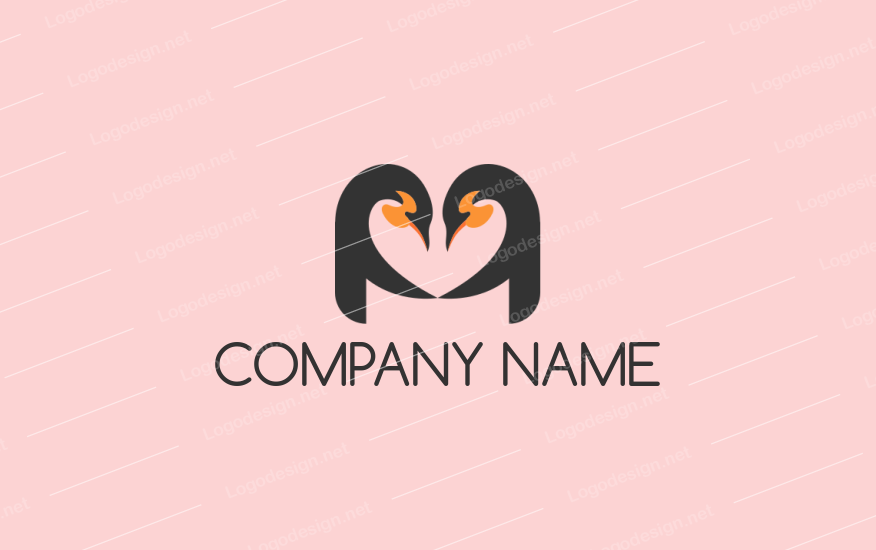
This logo looks, at first glance, just like two penguins, but the white space in between them besides creates a gentle centre shape, so vague that you might not fifty-fifty exist certain it was intentional.
Using Space to Create a Seamless Composition
It isn't always easy to know when you've hit the correct residue. Design — whether information technology be graphic design, art, logo, or anything else — is all near perception.
· That doesn't mean that at that place aren't any tips on using infinite well, though.
· Proceed in listen the gestalt principles mentioned previously hither. Operating by skillful pattern principles gives you the best chance of success.
· Acquire from others. Taking time to find the use of space can exercise a lot to teach you what works and what doesn't.
· Consider both bulletin and focus. It isn't just almost what your slice is near, just how it makes the viewer feel, that ends up influencing what the take-domicile is.
· Use ambiguous space judiciously.
· Go with your gut. Adjust, suit, and arrange. Play with the ratios of negative and positive, and if you lot don't like something, analyze why, then change it
Let's take a look at how others take used infinite in their compositions.
Examples — Negative Infinite and Positive Infinite In Action
Here are a few examples of effective pattern that uses negative and positive space to balance the composition and promote a seamless effect.

The previous Formula 1 logo used negative space quite equally balanced with positive to give definition to each chemical element involved. The F is curved and delineated by the 1; the cerise is cut into triangular ribbons by the negative space of the black, giving information technology a feeling of movement and dynamic action. The piece as a whole is composed to give the impression of a racing flag, which is an appropriate tone for a racing institution.

Artist Shigeo Fukuda is well known for trippy, optical illusionist affiche designs. This is a classic example of a utilise of positive and negative space that is balanced, fascinating, and ultimately a bit unsettling, reminding designers of why because tone is just every bit important as because focus.

This logo concept is intriguing because of how picayune variation it needs in club to promote both its message and tone. The negative infinite is used within the logo of the pen nib, which otherwise would be a straightforward element; however, with only the slight amending to the left, it aligns the element with the company name, Pendulum, and elevates the blueprint to "constructive."

This Chupa Chups advertizing makes employ of negative space that is already existent, or at least unsaid, in a piece of cored pineapple. Once more, the negative space is the background, rather than just plain white infinite, keeping the entire advertisement together as a harmonious whole.

This poster for Hard Rock Cafe and Casino also hits the blast correct on the head: using negative space, it clearly lets the viewer know the dual message information technology wants to promote, namely both music and nutrient.
Putting It All Together
Some types of design lend themselves more than easily to a heavier concentration on negative space, but basically what it boils down to is this: negative space and positive space are vital to design, and space is everywhere. Effective use can make or interruption your pattern, intelligent use can elevate your blueprint from skillful to corking, and balanced use tin give you a coherent, harmonious, seamless end production.
So when you start to outline your next project, remember to stop and look at information technology from a unlike perspective. What does the space betwixt add to your message? What tone do the residual and composition strike? What are you telling your audition by your use of space?
Overall, strive for balance between the two. Your white space is not just a matter of what got "left over" in the design; it's another opportunity, another canvass, another chance. Don't forget — using negative space tin can be a positive thing.
Source: https://medium.muz.li/negative-vs-positive-how-to-use-space-to-create-seamless-design-compositions-c9236eadee04
0 Response to "Balance Use Positive and Negative Space to Create Emphasis Art"
Post a Comment